EMDR (Eye Movement Desensitization and Reprocessing): Therapy in New Jersey | Internal Compass
- Nikki Hirsch

- Feb 24
- 3 min read
Updated: Mar 28
Updating What Feels Stuck
Trauma is not just what happened -it’s what your nervous system is still holding.
If you often feel braced, on edge, or reactive, even when you logically know you’re safe, nothing is “wrong” with you.
Your nervous system may still be responding to something it never fully processed.
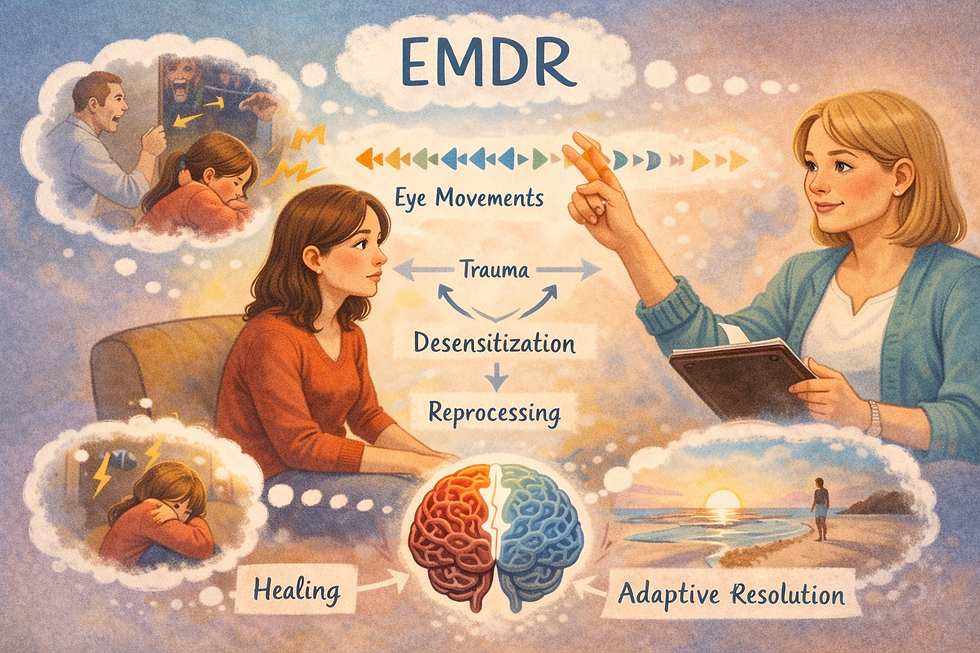
EMDR (Eye Movement Desensitization and Reprocessing) is a therapy approach designed to help the brain and body update experiences that feel unfinished.
When the Past Feels Present
Sometimes trauma looks dramatic. Other times it’s subtle and cumulative.
It can include:
Assault, accidents, or sudden loss
Chronic criticism
Emotional neglect
Growing up feeling responsible for others
Learning your needs were “too much”
Living in ongoing tension
Trauma isn’t measured by comparison. It’s measured by overwhelm.
When something exceeds your system’s capacity to cope, your body shifts into survival mode:
Fight. Flight. Freeze. Fawn.
Ideally, the system resets. But sometimes it stays prepared.
You may notice:
A constant hum of anxiety
Hypervigilance
Perfectionism or people-pleasing
Emotional shutdown
A harsh inner critic
Feeling small during conflict
This is not a personality flaw. It’s adaptive learning that hasn’t updated yet.
What Makes EMDR Different?
Your brain is wired to heal.
It naturally processes and integrates experiences - much like it does during REM sleep. But emotionally charged events can interfere with that updating system.
When memories stay “raw,” they continue influencing:
Your thoughts
Your body sensations
Your emotional reactions
Your beliefs about yourself
For example: You may know you are capable, yet still feel worthless in certain moments.
EMDR helps restart the brain’s natural adaptive processing system.
It does this by:
Organizing negative and positive beliefs connected to an experience
Using bilateral stimulation (eye movements, tapping, or tones)
Allowing the brain to reprocess the memory
Updating it with present-day information
The goal is not to erase the past. It’s to help it feel finished.
Why You Can’t Just “Calm Down”
If trauma lives in the nervous system, insight alone isn’t enough.
You can:
Understand your triggers
Practice breathing
Tell yourself you’re safe
And still feel activated.
EMDR works beyond logic. It helps the nervous system integrate experiences that are still signaling danger.
When processing completes, people often describe a subtle shift:
“I remember it but it doesn’t feel like it’s happening anymore.”
That difference matters.
What Does an EMDR Session Look Like?
Treatment Planning
You share your current concerns.
We explore how past experiences may be influencing the present.
A treatment plan is created around your goals.
EMDR may be integrated with other therapy approaches.
During Processing
You briefly bring a memory, belief, or sensation to mind.
Sets of bilateral stimulation are used (eye movements, tapping, or tones).
You notice what arises without needing to analyze it.
The process continues until the memory feels resolved or significantly less charged.
Long-standing issues may require multiple sessions.
After processing, we focus on integrating insights into daily life, helping your nervous system apply what it has learned.
We are here to answer your questions and give you more information. If you would like to get started click here.
QA
Do I Have to Share Every Detail?
No.
EMDR does not require you to recount every part of your experience. The brain does much of the work internally. You remain present and in control throughout the process.
Will I Become Overwhelmed?
Emotions and sensations can surface. You are prepared for this carefully and the pacing is intentional.
As experiences integrate, the emotional intensity typically decreases rather than increases.
Is EMDR Hypnosis?
No.
You are awake, aware, and in control during the entire session.
Can EMDR Help with Long-Term or Relational Trauma?
Yes.
EMDR is often particularly helpful for:
Chronic shame
Attachment wounds
Emotional neglect
Repeated criticism
Patterns that formed early in life
Trauma does not have to be one dramatic event to deserve healing.
Can EMDR Be Done Remotely?
Yes. We offer EMDR virtually.
Bilateral stimulation can be guided through on-screen eye movements, tapping, or audio tones. What matters most is preparation, pacing, and a strong therapeutic relationship. For some people, working from their own space actually supports regulation.
Healing Is Integration Not Erasure
EMDR is not about deleting your history.
It is about helping your nervous system metabolize experiences that are still activated.
As integration happens, you may notice:
Less reactivity
Less shame
More internal steadiness
More access to self-compassion
The ability to rest without bracing
The memory remains. But it no longer runs the present.
If you’re considering starting EMDR, we’re here to help. If you have any further questions or think you are ready.
👉 Contact Internal Compass today to get started.